Log in


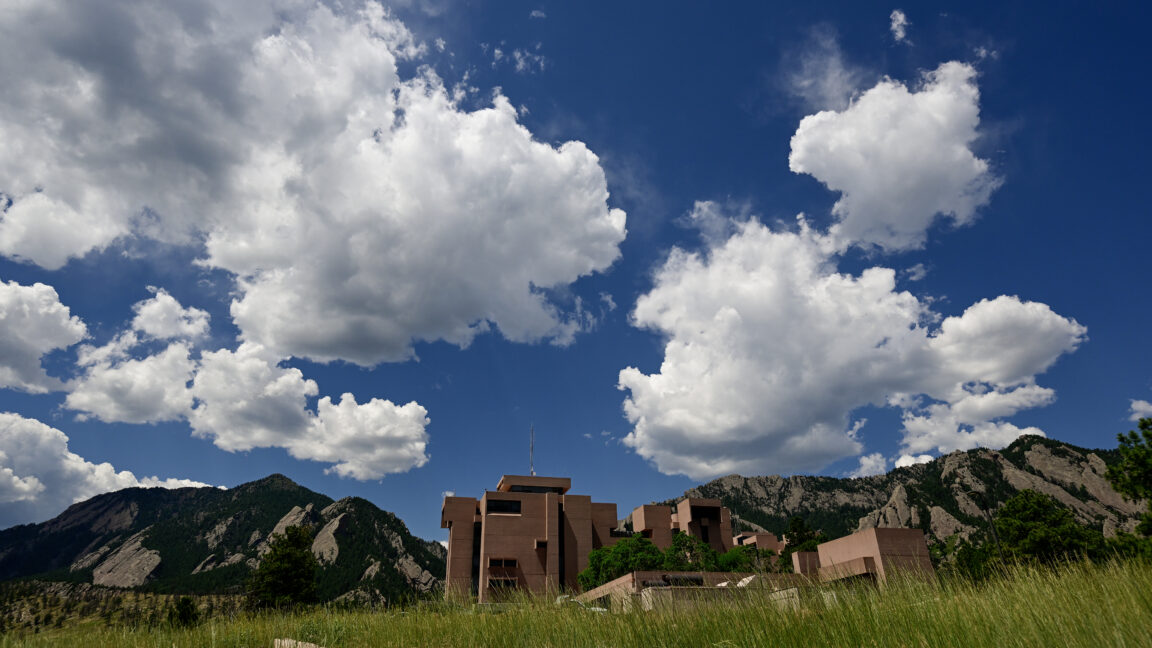
In December, the Trump administration abruptly announced it would shut down the National Center for Atmospheric Research (NCAR), a Boulder, Colorado-based facility that helps researchers perform studies of weather, climate, atmospheric chemistry, and more. The news came as a shock, given that the government had never identified serious deficiencies in the management of NCAR and its associated supercomputing center in Wyoming.
Nevertheless, the government ordered the University Consortium for Atmospheric Research (UCAR), which manages NCAR on behalf of the National Science Foundation, to help it prepare to transfer the Wyoming to a different operator. UCAR sued the government and, on Monday, won a preliminary injunction that places the transfer of the facility on hold.
Is that your final decision?
NCAR is what is termed a "Federally-Funded Research and Development Center" meant to support researchers in the academic community. Rather than having its own research agenda, it provides facilities, equipment, and expertise to support projects that are too large or complex for researchers to pursue on their own. NCAR has been around since the early 1960s and has become a critical resource for the global atmospheric science community.
So, it was a shock for many that the government would attempt to shut it down and distribute the resources it maintains, such as research aircraft and the supercomputing center. The government solicited public feedback on that decision, but UCAR took no chances and sued. As part of that suit, UCAR sought a preliminary injunction that would put the transfer of its supercomputing center on hold.
To get that injunction, UCAR would have to show that it was likely to prevail and that it would experience irreparable harm if the court didn't intervene.
The judge in this case, Brooke Jackson, ruled that the issue was one his court could address based on the Administrative Procedures Act. The government had argued that no decision had been made, and therefore that there were no grounds for the suit. But Jackson noted that as early as February—before the public comment period on the decision had even closed—government officials were telling UCAR that "[the National Science Foundation] has decided to transfer stewardship" of the supercomputing center.
By early March, a government program director was telling UCAR that he needed to "get this done quickly" and that documentation of the supercomputing center needed to be handed over "yesterday." Even now, months after the deadline for public feedback on the decision, the government admits it hasn't fully evaluated the comments it received. "The sequence of events strongly suggests that the outcome was predetermined," the decision notes.
For all of those reasons, he concluded that the NSF had already reached a final decision on the transfer of the supercomputing center, and that decision was subject to review under the Administrative Procedures Act, which is what the rest of the case hinged on.
Blocked
As in so many other cases that have made their way into the courts, the government does not seem to have been prepared to offer much of a defense of its actions. The Administrative Procedures Act prohibits actions that are "arbitrary and capricious," and Jackson found that there was a "failure to articulate any rationale" for the decision to relieve UCAR of its management role.
He noted that some internal documents introduced as evidence indicated that there was dissatisfaction with NCAR's pursuit of climate research and hosting of scientific programs intended to improve minority participation. But the government chose not to use those as arguments, so the court didn't need to evaluate them. UCAR, in contrast, introduced significant evidence that the decision to harm NCAR was part of a range of measures meant to pressure Colorado's Democratic governor about an unrelated matter.
Given that, the court concluded that forcing UCAR to give up its supercomputing center was arbitrary and capricious, and thus violated the Administrative Procedures Act.
UCAR was also able to demonstrate that it was suffering irreparable harm due to the uncertainty about its future. It has experienced unusually high levels of attrition among its staff, who have a rare set of technical skills and require additional training after hiring. And it expects it will be difficult to find replacements for them.
Given those circumstances, Jackson has issued an injunction blocking the government from forcing NCAR or UCAR to give up any resources related to the supercomputing center.
There are still additional threats to NCAR, including breaking it up, transferring other resources, and even selling its Boulder headquarters. So, this victory is far from the end of the threats. But the legal issues that decided the case are likely to apply to the additional threats, unless the government has a defense that it simply chose not to present here.